
“Guide” Aric Walton spoke with Elizabeth about her work with Agawam staff members. An abbreviated version of their conversation is below.
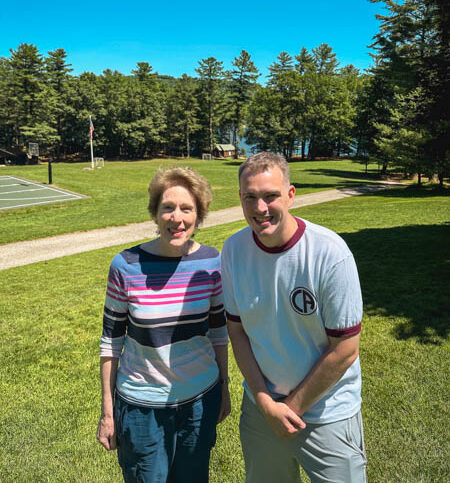
Elizabeth and Doc Potter during a visit
to camp in 2025
Elizabeth Hallowell: No, I didn’t come from a camping family at all. My connection began through my children. My daughter, Sarah, attended Alford Lake Camp, and through close friends “Capt” Pete and Suzy Caesar, my son Sam attended Camp Agawam in the early 1990s. During my visits, I started noticing something interesting—the skills that the counselors possessed were directly connected to what one needs for the workplace.
Guide: That’s a great observation. What prompted you to start volunteering your time as a career advisor for Agawam staff?
Elizabeth: My approach to resume writing is shaped by my background in education. What I’m doing is encouraging staff to reflect on what it is they’ve done and narrow down what they’re most proud of, what is most significant to them, what they have enjoyed the most—as a way of pulling out what is unique to them and not just a general job function list on a resume. I will have them tell me what they’ve done, order it in terms of what was most important and why, and then, using their words, we craft the entry on the resume. As a result of that process, they have a chance to really think through and articulate what it is that they have to offer a potential employer. While many people resort to generic templates, my approach strives to delve deeper into their accomplishments and break down what they specifically mean for the individual.
Guide: When you work with former counselors, what specific skills do you see them developing at camp that translate to the workplace?


The effective communication skills that Agawam counselors develop also stand out. There’s a real sense of listening, a sense of caring about the individual. There is also an emphasis on appropriate language, ways in which you can talk to a boy in a way that’s going to be encouraging but also accountable. There is a very high standard of behavior, character, and sportsmanship at Agawam. It’s genuine interaction.
Guide: How do these skills align with what employers are actually looking for?
Elizabeth: The National Association for Colleges and Employers has a career readiness framework that directly applies to the areas that members of the summer staff team operate within daily: problem-solving, working in groups, being part of a team, attention to detail, client service, and project management. A friend of mine who was a recruiter for Bank of America spoke about self-awareness—knowing how you learn and how you deal with things that you did not do well. Camp counselors develop all of these competencies.


Elizabeth: One of the big contributions that alumni can make is being a resource for each other. In my 25 years at Wheaton working with the alumnae network, I set up a protocol for how students would approach alums and how to make the most out of the informational interview. It’s important for alumni to realize how valuable and valued their advice is. When you’re reading about thousands and thousands of resumes going for jobs on Indeed or LinkedIn, the personal connection is more important than ever. And there’s another role for alumni: advocacy within your own organizations. You can help make sure that industries see the value in the skills that are acquired and don’t cheapen what these roles are. Potential employers should look at people who worked at a camp because there are transferable skills.


